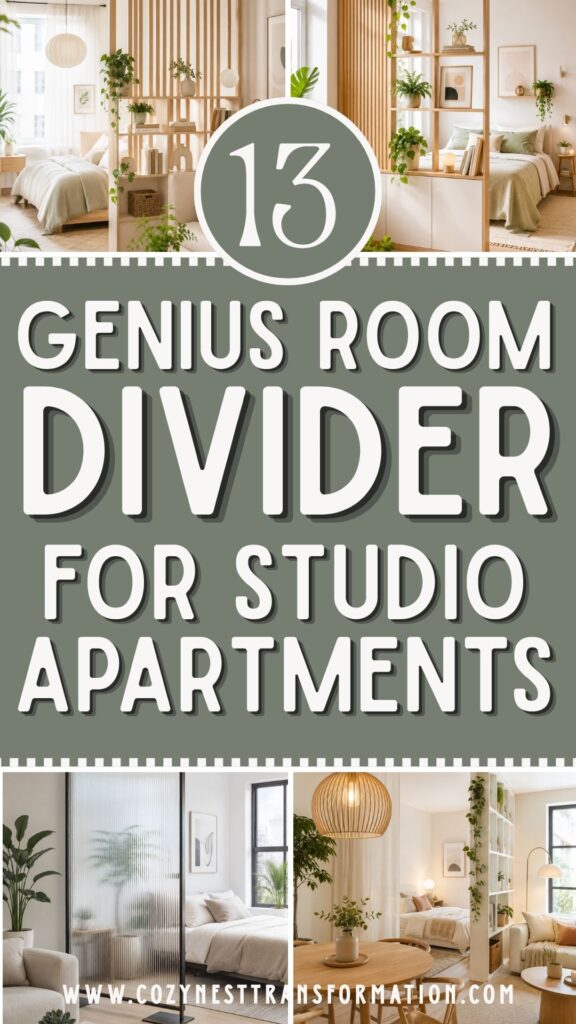
13 Genius Room Divider Ideas for Studio Apartments (That Don’t Use Walls)
This post is all about room divider ideas for a studio apartment.
Living in a studio apartment is a bit of an art form.
You’re working with one open space that has to be your bedroom, living room, dining area, and sometimes your home office, all at once.
I’ve been there, and I know how quickly it starts to feel like you’re sleeping three feet from your couch while also staring at last night’s dishes.
The good news? You don’t need to knock down walls or call a contractor to carve out some actual zones in your space.
There are so many clever room divider ideas that create real separation without touching a single wall. They look genuinely great, and some of them are my favorite, too.
Here’s what’s actually worked for people I know and me.
13 Genius Room Divider Ideas
1. Bookshelves That Face Both Ways
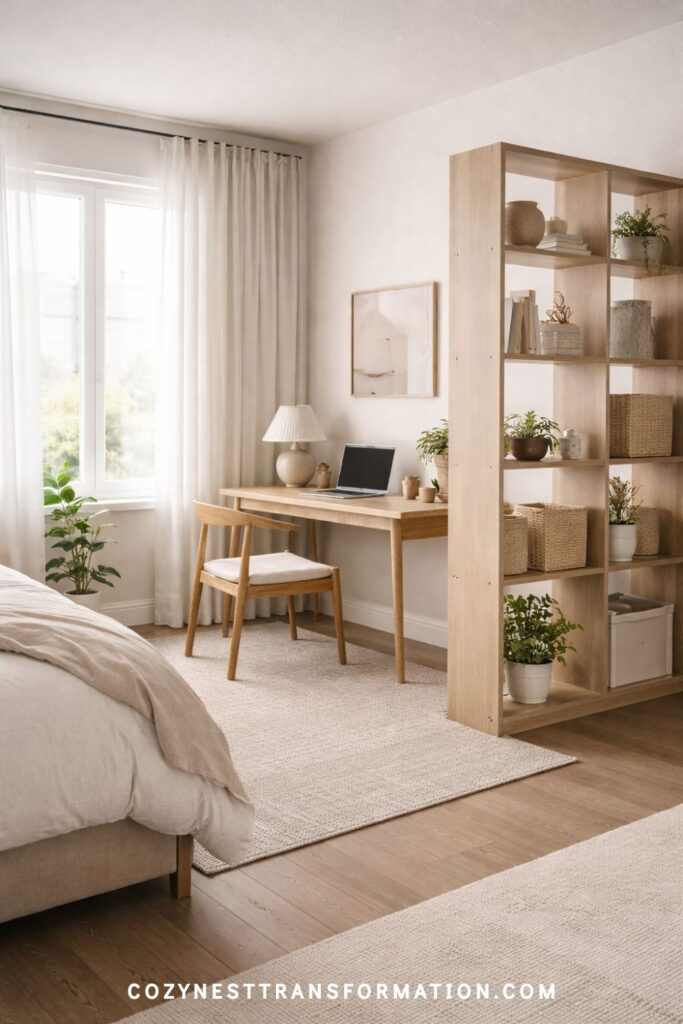
A tall, open bookshelf is probably the most practical room divider you can use in a studio.
It blocks sightlines without completely cutting off light, and it doubles as storage.
Which you desperately need when you’re in a smaller space.
The key is going open-backed. If you use a solid-backed unit, you kill the light on one side, and it starts to feel like you’ve built a wall.
Open shelving lets the room breathe while still creating distinct zones.
Put books on one side, plants and decorative stuff on the other.
Boom — your sleeping area feels separate from your living area without actually being separate.
If you want to go a step further, some people angle two bookshelves in an L-shape to create a little nook feel. That works really well for a bedroom corner specifically.
2. Curtains Hung From the Ceiling
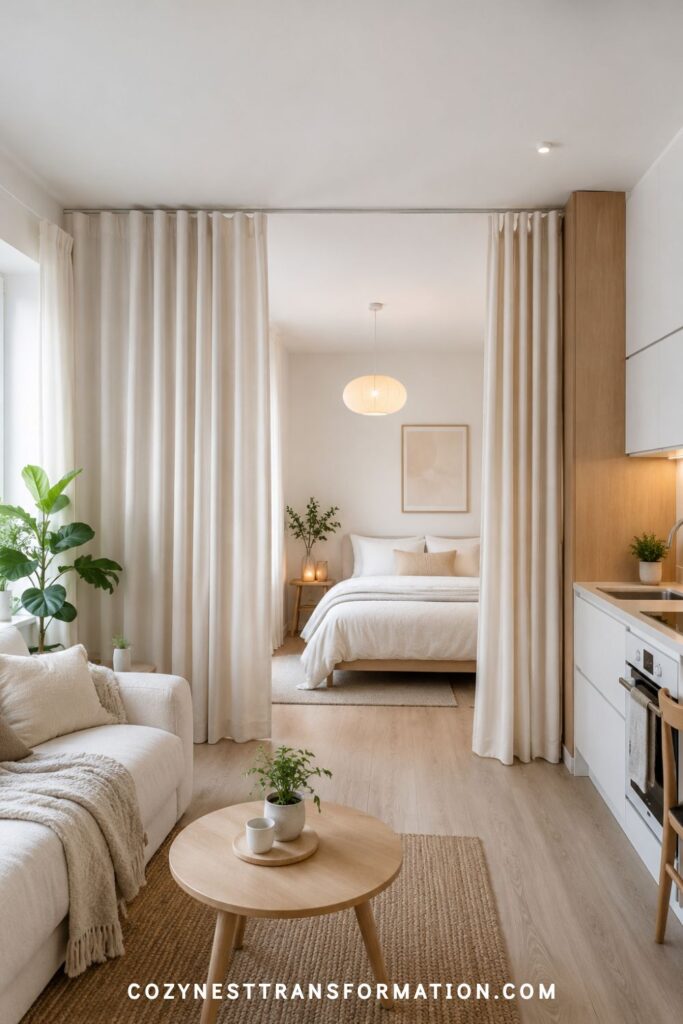
This one is massively underrated as a room divider idea.
Ceiling-mounted curtain tracks or even a tension rod system installed higher up let you draw a full-length curtain across your space whenever you want privacy.
What I love about this curtain hanging from the ceiling is the flexibility. When you have people over, push the curtain to the side, and the space feels big and open.
When you want to sleep in, and your partner is already up watching TV, you close it. Done!! No permanent structure, no fuss.
I love linen curtains for this, and they work especially well here because they’re light enough not to feel cave-like, but thick enough to block some sound and sight.
Velvet, if you want drama. Pick a sheer if you mostly want the visual separation rather than actual privacy.
3. Plants — But Done Properly
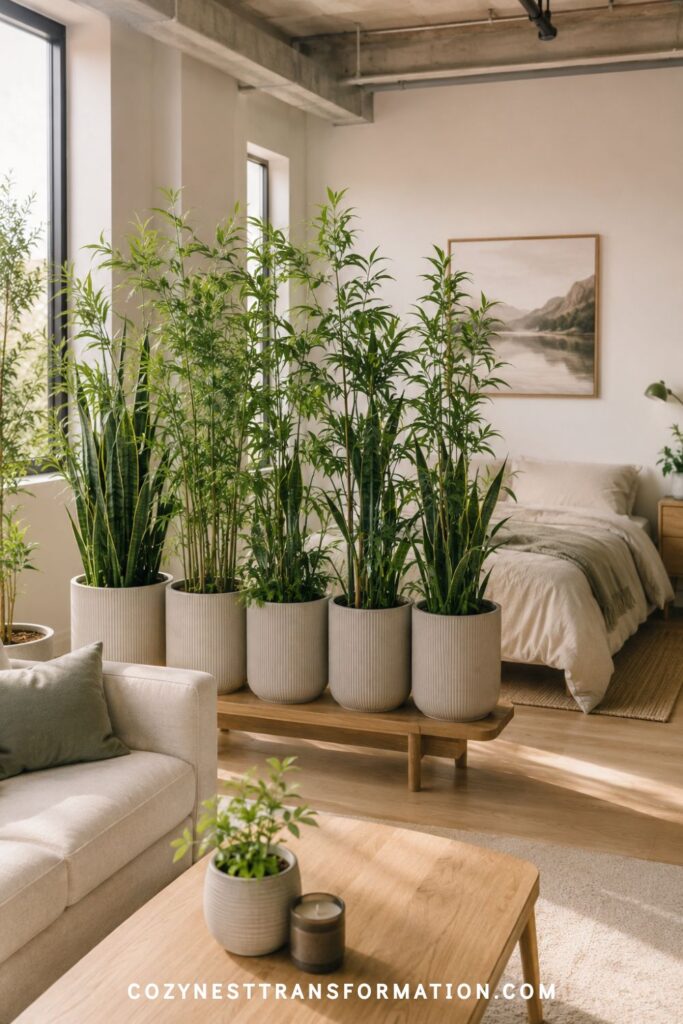
Look, I’m not talking about one sad fiddle-leaf fig in the corner.
I mean a proper row of tall plants, think snake plants, olive trees, bamboo in planters, or a line of tall dracaenas, placed everything intentionally to create a soft visual boundary.
Used as room dividers, plants work best when they’re roughly the same height and spaced close enough that your eye reads them as a barrier.
You can put them in matching planters on a low console table or just group floor planters together.
This approach works surprisingly well as a room divider for bedroom separation in studios, because it’s not harsh.
There’s no hard line; it just naturally suggests “this is a different zone.”
Plus, plants genuinely make a small space feel better, not just look better.
Related: 13 Best Ways to Decorate a Living Room with Indoor Plants (Even in Small Spaces)
4. A Low Platform Bed Frame (With Storage)
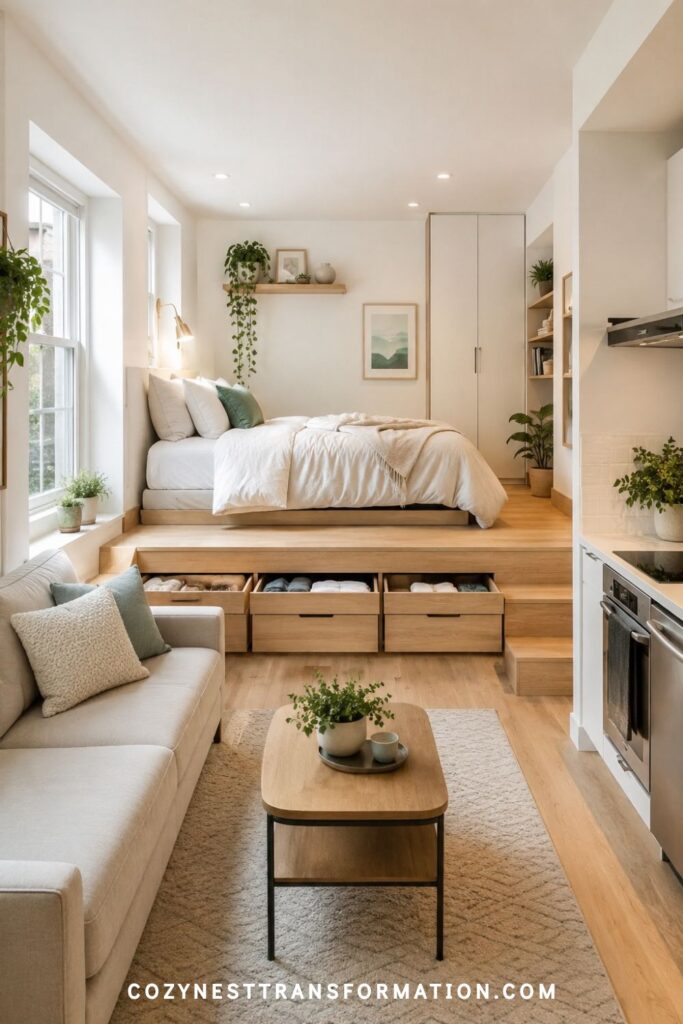
This one is more structural than the others, but hear me out — it doesn’t involve walls.
Raising your sleeping area on a built-up platform instantly signals “this is the bedroom” without any kind of partition.
Combined with a low headboard or even just the change in floor level, it creates a psychological separation that actually works.
Some people go further and put the platform on one side of the room with a step up, which makes the bedroom area feel genuinely distinct.
Add lighting at the step, and it looks intentional and designed, not like a college DIY project.
31 Small Bedroom Decorating Ideas (That Don’t Feel Cramped)
5. A Sofa as a Divider
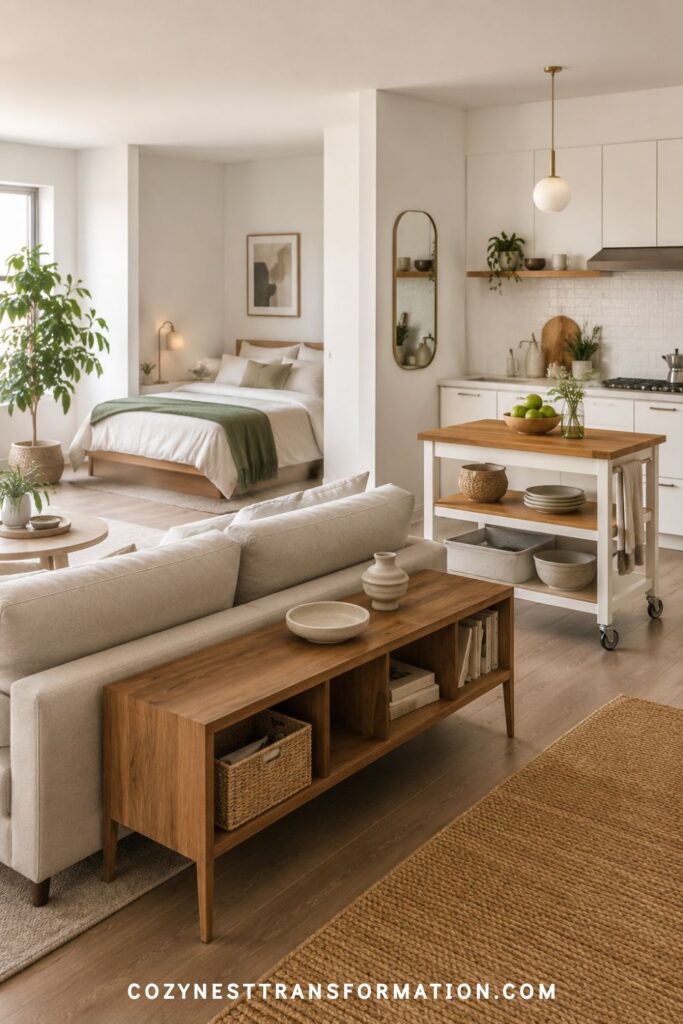
Your sofa is probably already doing some of this work, but most people push it against the wall and miss a trick.
Pull the sofa out into the room with its back facing the “bedroom” side of your studio.
That back of the sofa becomes a natural divider between your sleeping space and your living space.
Pair it with a narrow console table on the back of the sofa (a sofa table, technically), and you’ve got extra surface space plus a visual barrier.
It reads as an intentional furniture arrangement rather than a workaround, which matters in a small space.
21 Best Small Couches for Small Spaces (Stylish & Space-Saving)
6. Shoji Screens and Room Divider Panels
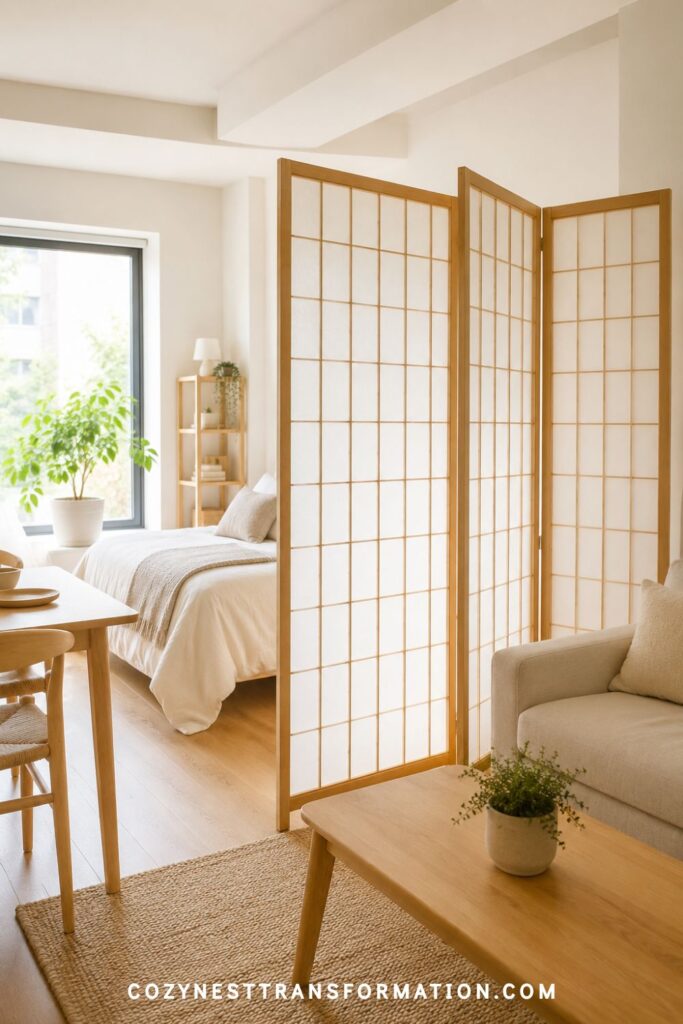
Folding screens have been solving the “how to separate a room without walls” problem for centuries.
The panel divider gives you a movable, repositionable room divider that you can tuck away entirely when you want the space open.
Shoji-style screens, which are the ones with the rice paper or frosted-panel look, are especially good because they let light filter through rather than block it.
In a small apartment, keeping the light moving through the whole space is important.
There are also heavier, more solid panel dividers that give you more visual privacy if that’s what you’re after.
Three or four connected panels can close off a sleeping corner effectively without feeling claustrophobic.
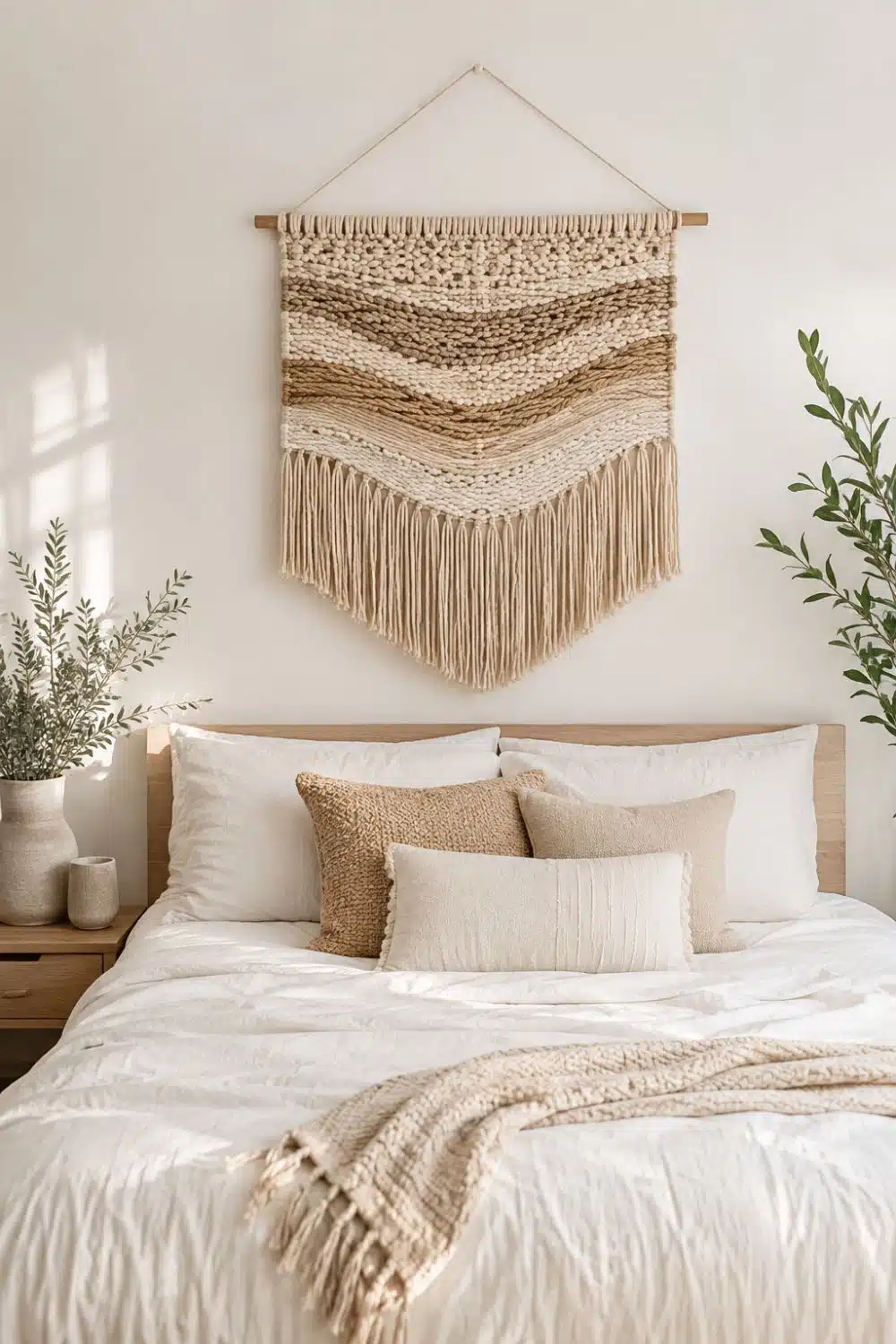
7. Hanging Macramé or Rope Dividers
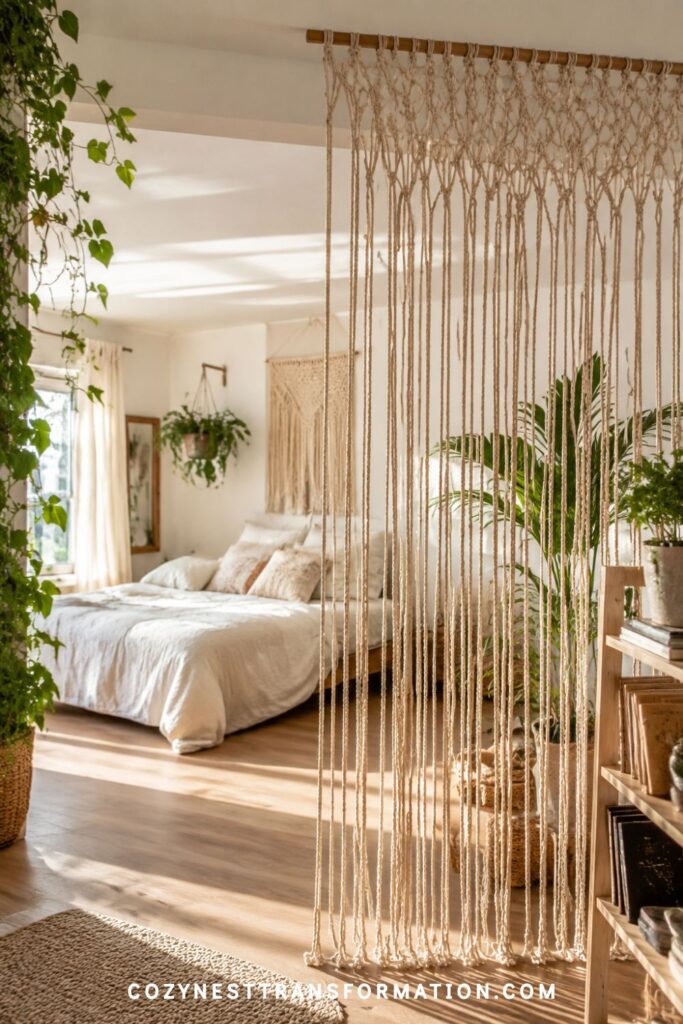
Not for everyone, I know.
But if your vibes are bohemian, and you want something that doesn’t feel like furniture.
You can go for a large hanging macramé piece, or a row of hanging rope dividers can create a real visual boundary, as shown in the image.
The nice part is that these don’t block light at all.
They create separation through texture and layering rather than opacity.
Works best as a room divider idea for bedroom zones in studios where you don’t need actual privacy so much as a visual cue that you’re in a different part of the room.
8. Built-In Storage Walls (DIY-Friendly Versions)
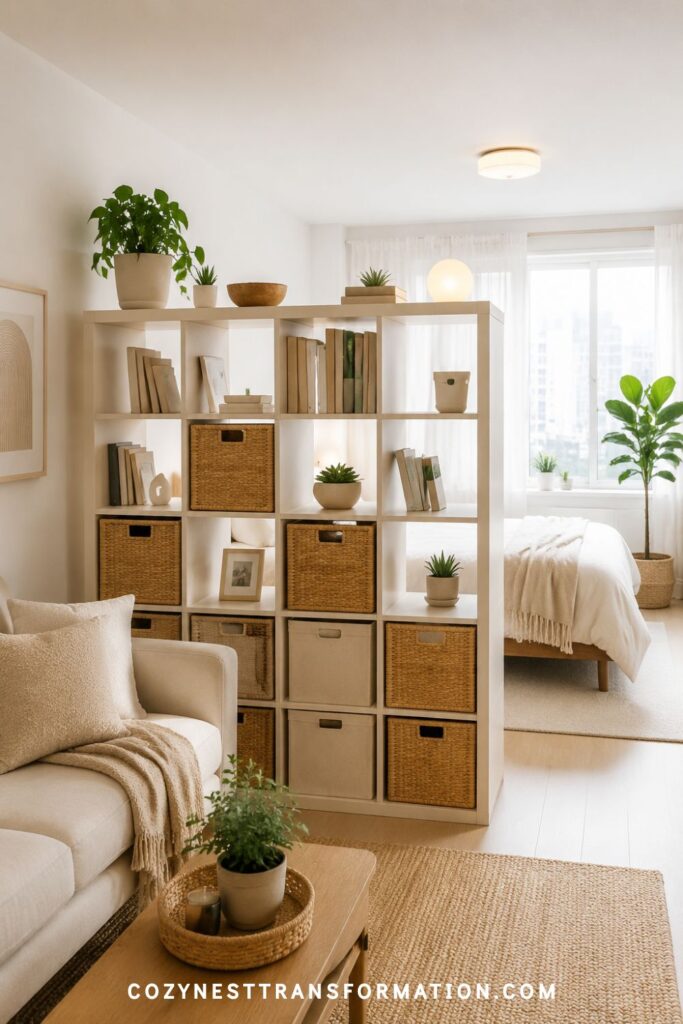
If you want something a bit more permanent but still renter-friendly, I suggest room divider ideas for a studio apartment.
You can stack modular storage units and a cube shelving unit to create a divider wall that’s actually built from furniture.
The freestanding kind that doesn’t need to be anchored to walls is perfect for studio apartments, where you can’t make changes.
Stack them double-height if you need more separation, and fill them with books, baskets, and stuff you’d need to store anyway.
This is one of those room divider ideas that genuinely earns its floor space because it’s doing two jobs.
The 19 Best Storage Solutions for Small Living Rooms That Actually Work
9. Rugs to Define Zones
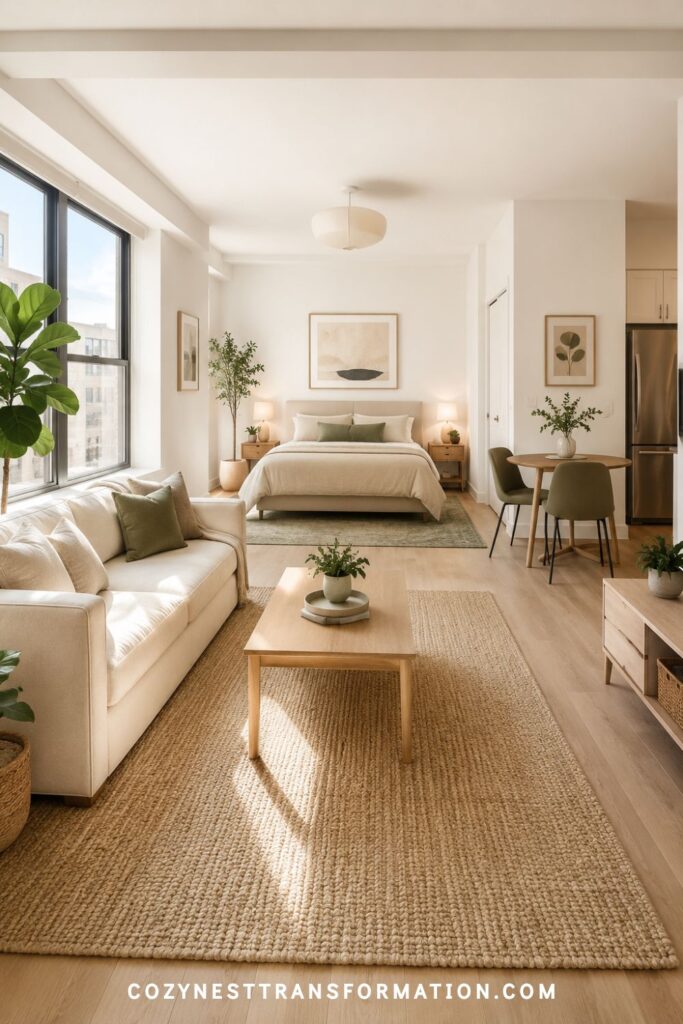
My personal favorite, but this one’s less about vertical separation and more about psychological zoning, but it works.
Two distinct rugs, one under the sofa setup, one under your bed, do a lot of the heavy lifting in a studio because they visually anchor each zone and stop the space from feeling like one formless blob.
The rugs don’t need to match, but they should feel like they belong in the same apartment.
Two completely different-colored, clashing rugs can make a studio feel chaotic.
Two rugs with a shared color or similar weight work well together.
You can pair this really well with other room dividers on this idea list.
10. Pegboards and Slatwall Panels
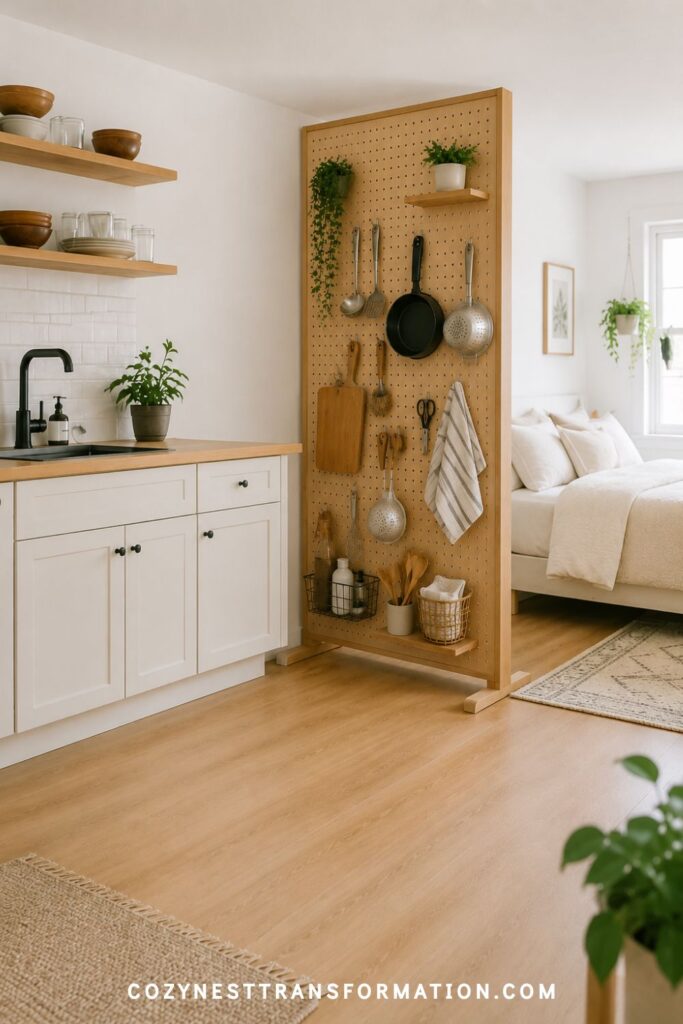
A large pegboard mounted on a freestanding frame becomes a functional room divider that also stores things.
You can hang kitchen tools on one side if it’s dividing a kitchen-adjacent area, or put hooks for bags, hats, and accessories on a side facing your entryway zone.
Slatwall panels (the kind you see in retail stores) work similarly and look more finished.
Both options are modular and repositionable, which matters when you’re in a rental and might move things around.
11. Glass or Acrylic Panels
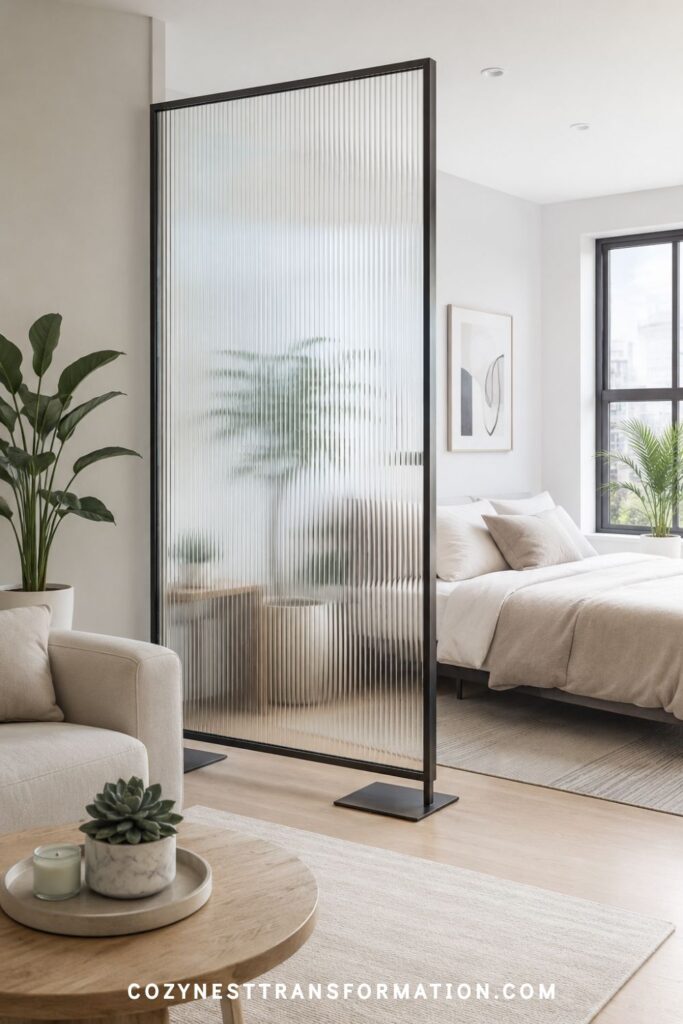
Honestly, as an architect and interior designer, when I want space separation without losing any light, I suggest glass or acrylic panels to my clients.
These framed glass or acrylic panels on a freestanding base are genuinely good options.
They look more architectural than most of the other ideas here!
Almost like a proper room divider in the traditional sense, but they’re still freestanding and moveable.
Frosted or ribbed glass gives you some privacy without being opaque.
Clear acrylic looks very modern and almost invisible, which can actually make a small space feel bigger even while dividing it.
12. Sliding Barn Doors on a Floor-Mounted Track
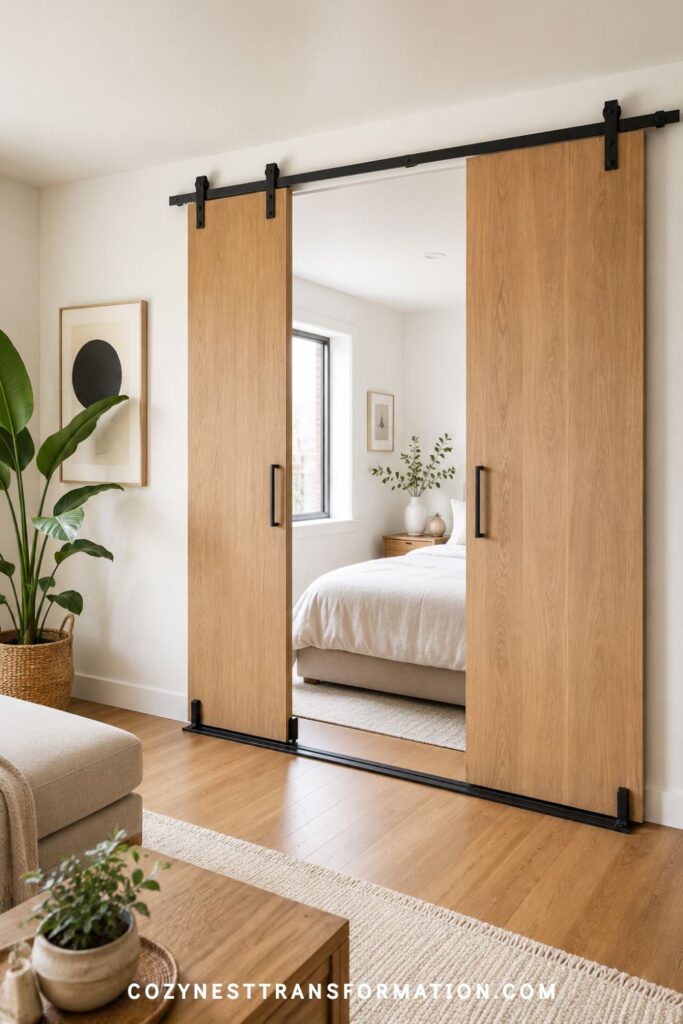
Standard barn doors hang from a ceiling-mounted track, but if you can’t drill into your ceiling, floor-mounted sliding panels are a real option.
They’re more stable than folding screens, can cover a full doorway-width of space, and have a more finished look than curtains.
This works especially well if your studio has a natural chokepoint, like a hallway section between the main space and an alcove, where a sliding panel can effectively create a “bedroom” feel.
13. Hanging Pendant Lights to Anchor Zones
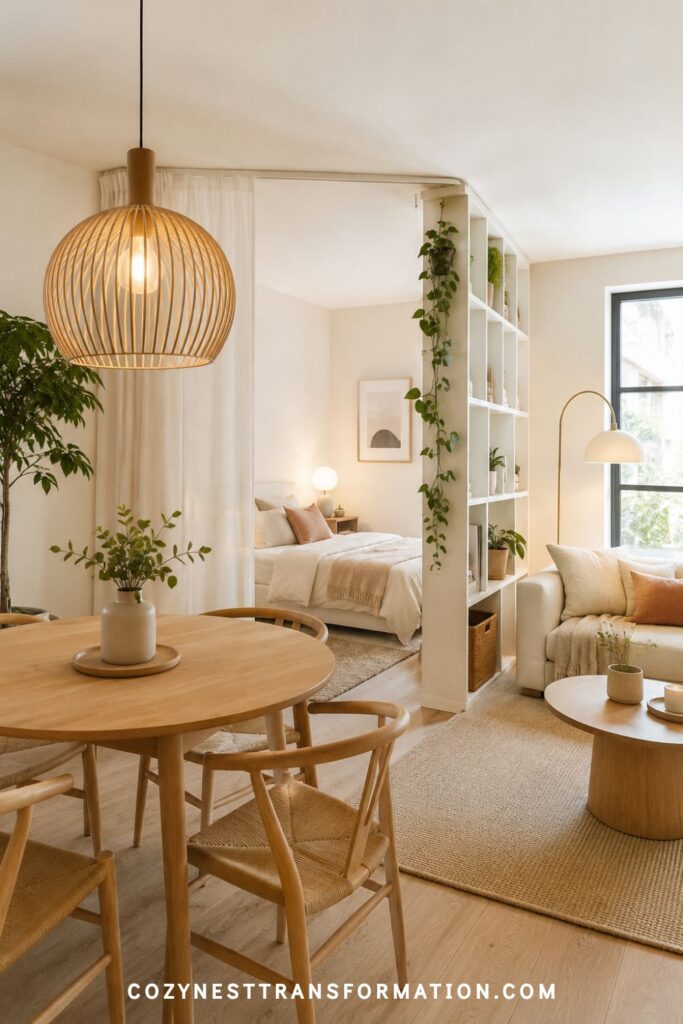
Not a physical divider, but hear me out.
Lighting is one of the most underused tools for separating a room without walls.
A pendant light hung specifically over your dining area, a reading lamp positioned deliberately in one corner, and bedside lighting in your sleeping zone together, these create pools of light that psychologically separate the space.
When the overhead light is off, and your zones have their own lighting, a studio apartment suddenly feels like it has rooms.
This one doesn’t replace the other room divider ideas on this list, but it amplifies all of them.
What Actually Works in a Real Studio
Honestly, the best approach is almost always to combine a few of these.
A rug to define the living zone, a bookshelf facing the bedroom side, and curtains for when you actually need privacy, cover about 90% of studio living situations.
The whole concept is about segregating the area without walls, so you’re not trying to build rooms. You’re trying to make the space feel less like everything is on top of everything else.
In my honest opinion, the room divider ideas that pull double duty are the best.
A shelf that divides and stores. A sofa that divides and gives you a surface. A plant row that divides and makes the air better.
In a small space, anything that only does one job is a luxury you probably can’t afford.
The goal is a studio that doesn’t feel like you’re living in one large, formless room — and with the right room dividers, even a small space can feel surprisingly intentional.
Final Thought on Room Divider Ideas

This post was all about 13 Genius Room Divider Ideas for Studio Apartments (That Don’t Use Walls).
Read Next:
- 47 Small Apartment Decorating Ideas on a Budget (Renter-Friendly)
- 7 The Best Ikea Sofa Beds For Small Spaces (That Actually Fit!)
- 23 Best Small Living Room Layout Ideas in a Small Apartment
- 13 Brilliant Small Cloffice Ideas That Actually Work in Small Apartments