11 Bedroom with Desk ideas That Actually Solve Small Room Problems (An Architect’s Take)
This post is all about 11 Smart Bedroom with desk ideas.
Most bedroom desk advice tells you where to put things. Nobody explains why that placement works or why the wrong one makes your room feel cramped, even when it technically fits.
I’m a qualified architect and interior designer, and I work from home.
I’ve solved this layout problem professionally for clients and personally in my own apartment. These 11 solutions come from both.
Here’s what most guides skip: a bedroom with a desk isn’t a furniture problem.
It’s a spatial planning problem. Once you understand the rules behind each layout, you stop guessing.
Why Most Bedroom Desk Setups Feel Wrong
Before the layouts, one concept you need: circulation zones.
In architectural planning, every room needs a minimum of 90cm (about 36 inches) of clear walking path between pieces of furniture.
Drop below that, and the room doesn’t just feel small; it creates low-grade stress every time you move through it.
I saw that most people place a desk, and love how it looks in the corner.
Then wonder why the room feels suffocating. Usually, it’s because the desk ate the circulation path between the bed and the wardrobe.
Keep that 90cm rule in your head as you read through these.
11 Bedroom with Desk Layouts That Actually Work
1. The 90-Degree Window Alignment: Maximum Light Without the Glare Problem
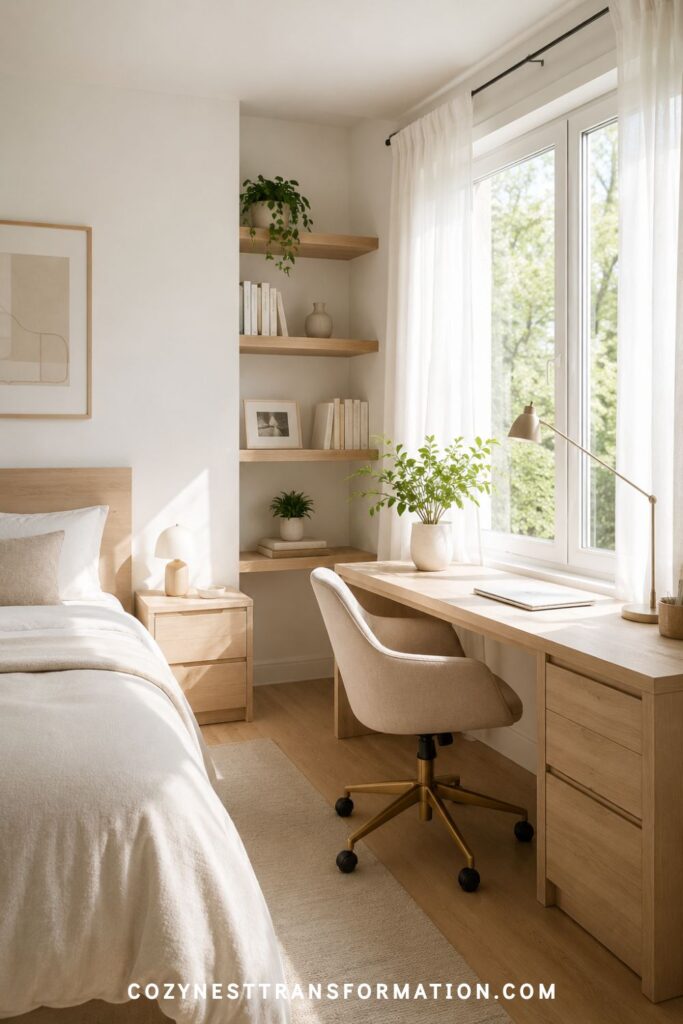
Positioning your desk perpendicular to the window, not facing it, not with your back to it, is the standard architectural solution for home office lighting.
- Facing the window: screen glare and eye fatigue by afternoon.
- Back to the window: harsh shadow across your work surface.
- Perpendicular: natural light hits your desk from the side, which is how drafting studios and professional studios have been lit for centuries.
Pair it with sheer curtains to diffuse direct sun when needed. This is the layout I use personally, and it’s the one I always recommend to my clients with window-facing desks.
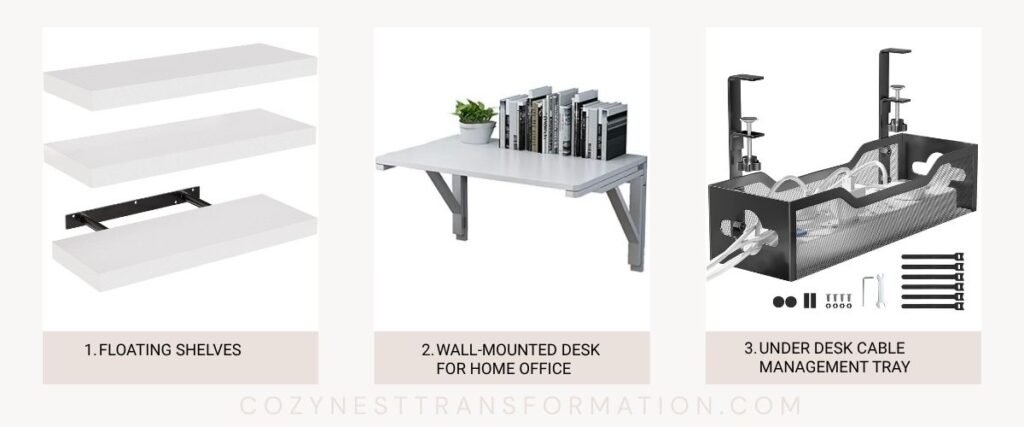
2. The Floating Desk Formula: How to Save Floor Space Without Losing Workspace
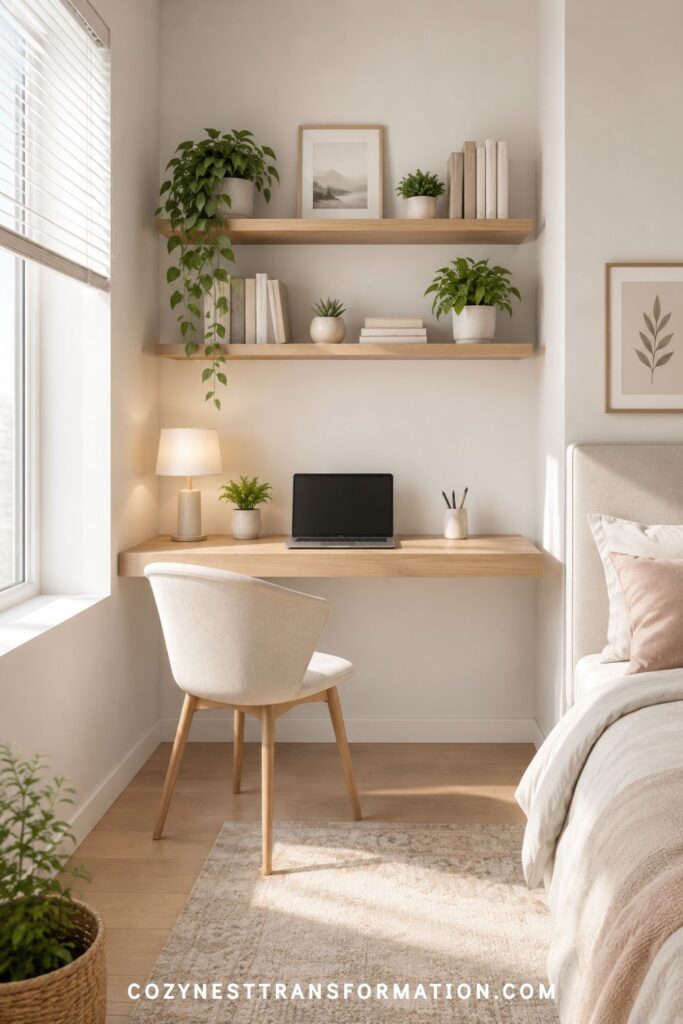
A wall-mounted floating desk saves floor space, but most people mount it too low, making it painful to use for hours.
The correct ergonomic height is 73–76cm from the floor to the desk surface for seated work.
When you wall-mount, measure this before drilling. The desk should sit at elbow height when you’re seated.
Mount floating shelves directly above, with a minimum clearance of 45cm above the desk surface to avoid hitting your head, and push storage vertically rather than outward.
This layout is ideal for rooms under 10 square metres where every square metre counts.
3. The L-Shaped Zone Plan: Defining Work vs Sleep Without Walls
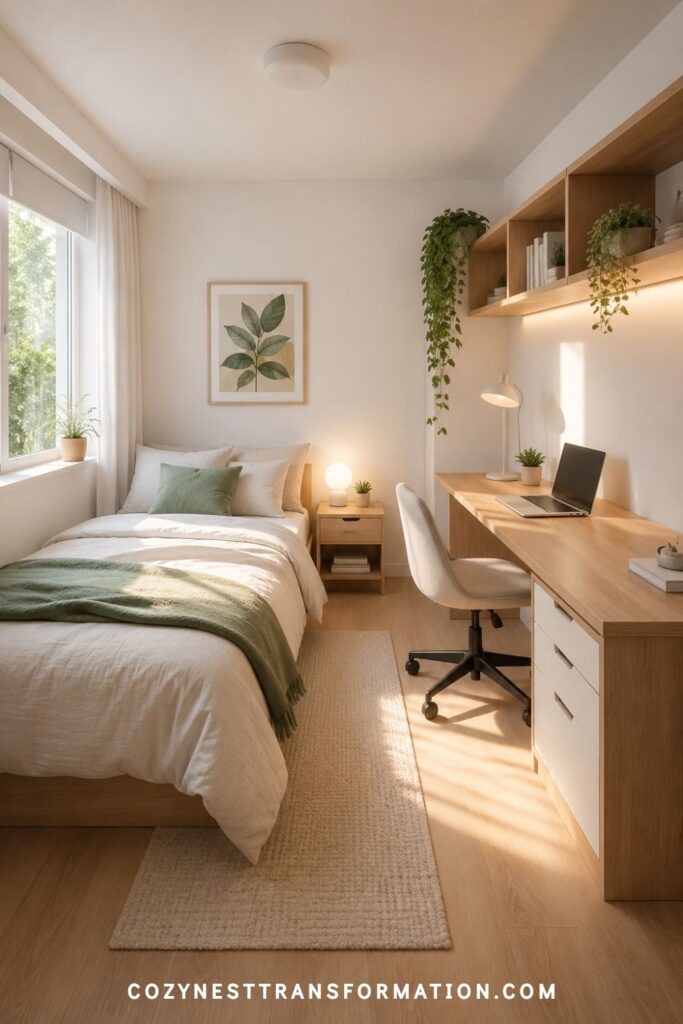
An L-shaped layout places the bed along one wall and the desk along the adjacent wall, creating two distinct zones from a single corner.
This works architecturally because the two functions face different directions. Y
I believe this is a great layout for separating zones so that our eyes don’t land on the desk from the bed, and you don’t face the bed while working.
It’s spatial separation without a physical divider.
This bedroom with desk layout works best in square rooms (roughly 3m × 3m or larger).
In narrow rectangular rooms, it fights the circulation path. Check your 90cm clearance between the foot of the bed and the desk chair when pulled out.
4. The Built-In Efficiency Stack: Wardrobe + Desk in One Run
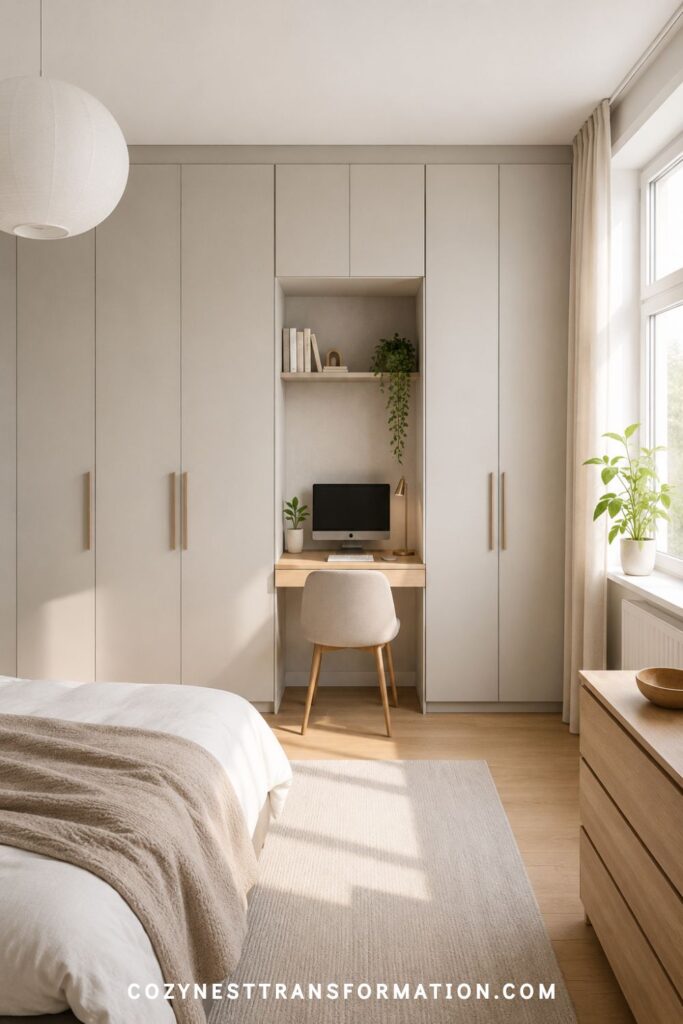
Building a desk into a wardrobe, a continuous unit of storage that incorporates a recessed desk section, is the most space-efficient permanent solution for a small bedroom.
The desk sits flush within the cabinetry, so when you close the surrounding doors, the room reads as a wardrobe wall rather than a combined office-bedroom.
IKEA’s PAX system is my favorite and perfectly suits this layout.
It handles this well with the right combination of frames and fillers.
I suggest keeping the desk section narrower than you think; 80cm wide is functional for a single monitor.
Wider than that, and it starts to dominate the wall.
5. The Dual-Function Nightstand Desk: Small-Space Arithmetic
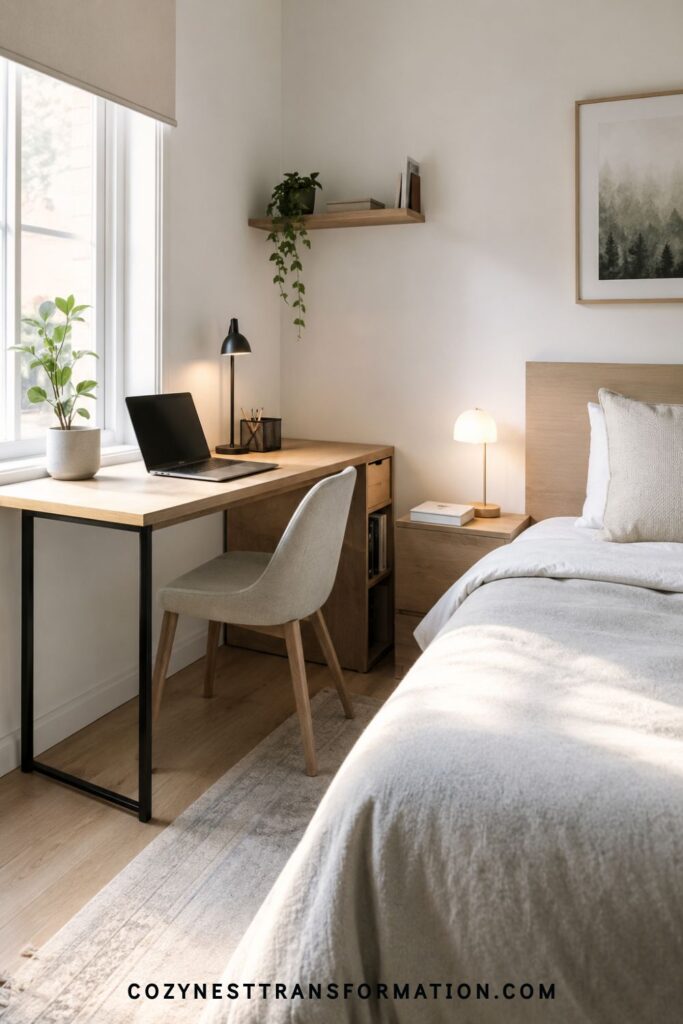
If the room genuinely cannot accommodate a separate desk, a narrow desk placed alongside the bed can serve as both workspace and nightstand.
The rule here: keep the desk surface clear of personal items on the sleep side.
Visually, clutter beside your bed signals the brain to stay alert.
A lamp, one book, that’s it. The work side handles everything else.
This only works if you can close the laptop or turn off the monitor.
An always-on screen beside your bed will affect your sleep.
6. The Dead-Corner Solution: Turning Awkward Angles into Workspace
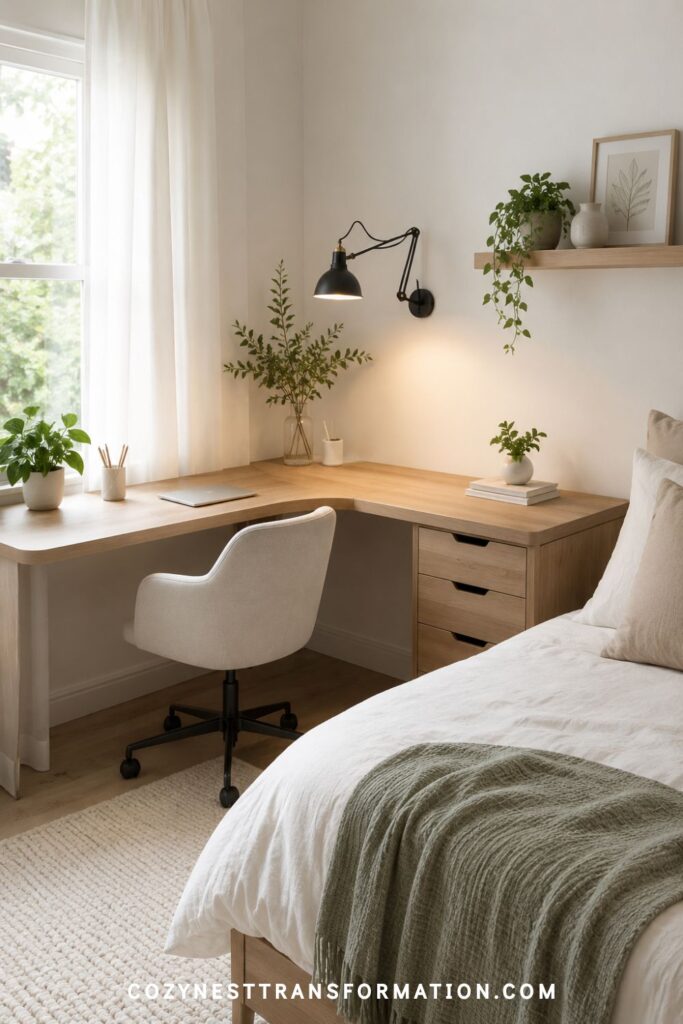
Every room has at least one architecturally useless corner.
Too narrow for furniture, too small for a wardrobe section, and often just collecting clutter.
An L-shaped or triangular corner desk drops directly into this space and uses both walls for structural support.
The result is a surprisingly large work surface from a space that previously contributed nothing to the room.
Wall-mounted task lighting (sconces or articulated arm lamps) works better here than a desk lamp.
Because it keeps the desk surface clear and throws light exactly where you need it.
7. The Loft Bed Office: Full Vertical Separation
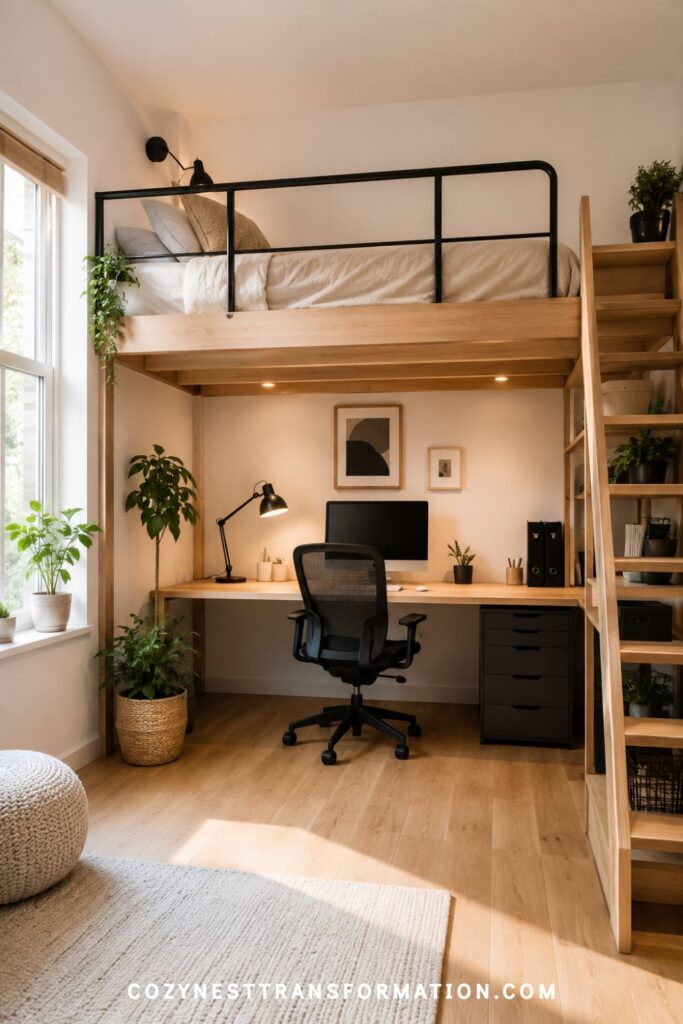
In a room under 15 square metres, a loft bed with a desk underneath is the best thing to add to a room without adding square metres.
Architecturally, this creates vertical zoning: sleep above, work below!
Which is a stronger psychological separation than anything you can achieve on a single horizontal plane.
The ceiling over the lower zone compresses the space slightly, which most people find makes the desk area feel more focused, not claustrophobic.
Trust me, you should consider the clearance in this bedroom with desk idea.
You need at least 90cm between the desk chair (at seated height) and the loft base above it.
Less than that and you’ll feel the ceiling before you even sit down.
8. The Fold-Down Wall Desk: The Room Reclaims Itself After Work Hours
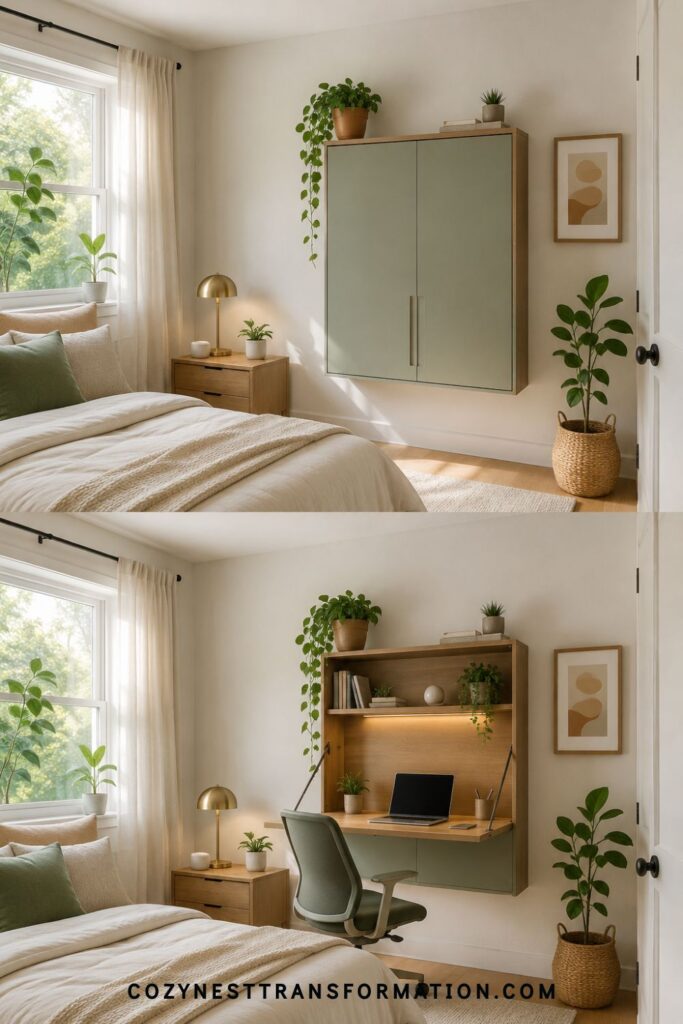
A wall-mounted fold-down desk is the only layout on this list where the desk literally disappears.
Fold it up, and the room is a bedroom. Fold it down, and it’s an office.
This suits anyone whose mental switch between work and rest is hard to flip.
The physical act of folding the desk away is a closing ritual — a clear end to the workday that a permanent desk doesn’t give you.
Weight capacity matters more than people realise.
Most residential fold-down desks hold 15–25kg. If you run two monitors, check the load rating before purchasing.
9. The Cloffice: Converting a Reach-In Closet into a Dedicated Office
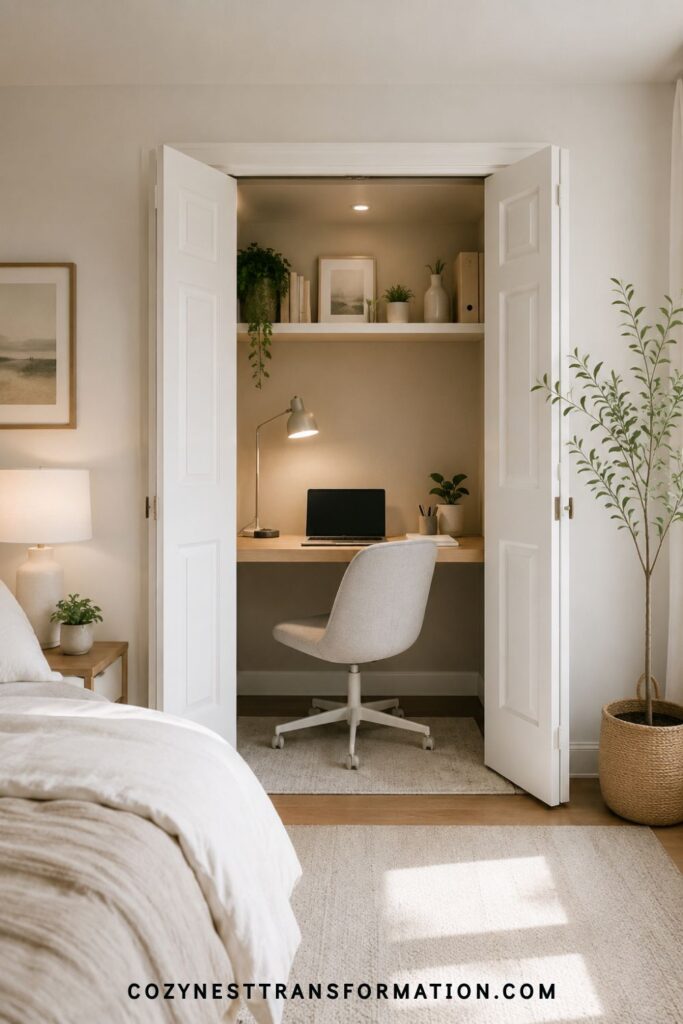
A reach-in closet, typically 90–120cm deep and 90–150cm wide, is almost exactly the footprint of a functional home office.
Strip the hanging rail, add a desk surface, run power inside, add task lighting, and you have a workspace that closes behind doors at the end of the day.
This is the cleanest separation of the options here.
When the closet is closed, there is no desk in your bedroom.
Cognitively, that matters more than most people expect.
Ventilation is the detail most cloffice guides skip.
If you’re in there for hours, you need airflow.
A small USB-powered fan or leaving the doors slightly cracked usually handles it.
For a full step-by-step breakdown: Best Cloffice Ideas: How to Plan, Organize, and Set Up in 7 Easy Steps
10. The Command Position Layout: A Feng Shui Principle With a Real Architectural Basis
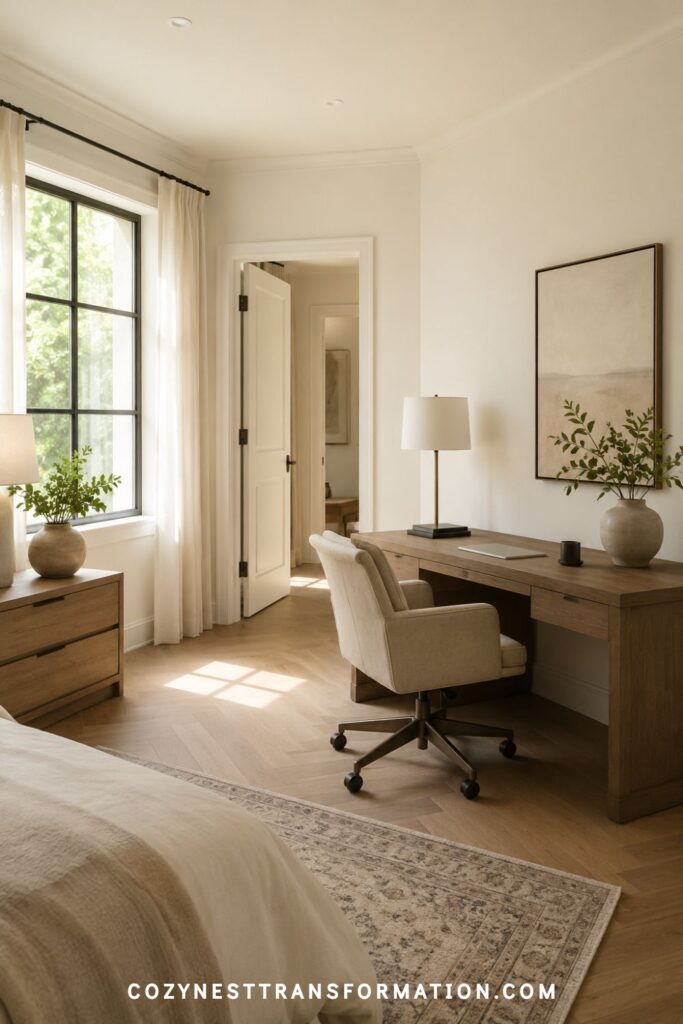
In feng shui, the “command position” means placing your desk so you can see the door without sitting directly in line with it, typically a diagonal placement.
In my view, this works: your nervous system monitors entry points.
Sitting with your back to a door keeps a low-level of attentiveness.
Sitting facing a wall does the same — you’re cut off from spatial information.
A diagonal placement gives you peripheral awareness of the door without forcing you to face it directly.
This isn’t mysticism. It’s how corner offices got their reputation.
11. The Floating Corner Desk: The Easier Version of Layout 6
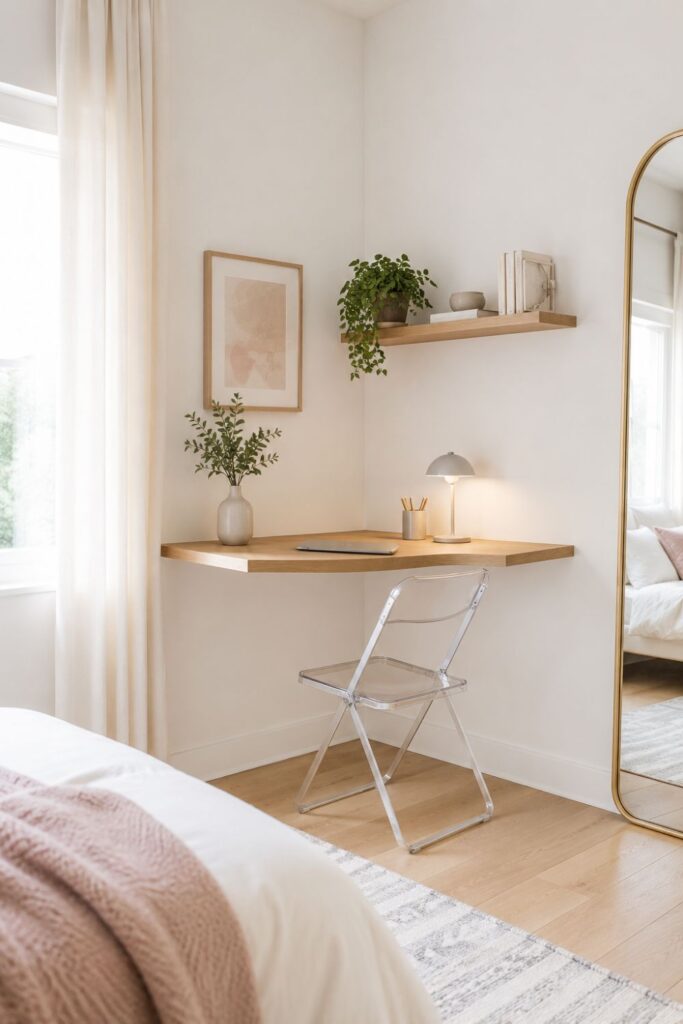
Where Layout 6 uses a freestanding corner desk, this version wall-mounts a compact floating desk into the corner, using both walls as support.
The advantage over a freestanding corner desk: no legs means no floor obstruction, which keeps the circulation zone completely clear.
The disadvantage: installation requires studs or wall anchors in both walls, so you need to confirm your wall construction before committing.
A slim tuck-away chair, think a folding acrylic or bentwood style, completes this setup without adding visual bulk.
The Details That Actually Matter for a bedroom with desk layout
Lighting (More Than You Think)
Most small bedrooms run on a single overhead bulb.
That’s not enough for desk work, and the color temperature is usually wrong.
Ceiling lights tend toward warm tones designed for relaxation, not focus.
Add a task lamp at 4000K colour temperature for daytime work, switchable to a warmer tone for evenings.
Creating Visual Separation in the Bedroom with Desk Ideas
You don’t need a wall to separate sleep from work.
A rug under the desk area, a different wall treatment, or even just consistent positioning (desk always faces away from the bed) trains your brain to read the zones as distinct.
Avoid positioning the desk so that your eyeline from the pillow lands directly on a screen.
Even powered off, a monitor in that position keeps the brain slightly alert.
Storage Without Clutter
Vertical is always the answer in a small room.
Floating shelves above the desk, wall-mounted cable management, drawer organisers inside, rather than items stacked on top.
The desk surface should hold only what you need for the current session.
The One Mistake That Kills bedroom with desk layout
Place the desk first, then fit everything else around it.
The desk gets placed last, after the bed position and wardrobes are confirmed, and the circulation paths are protected.
Once you know where the 90cm walking zones need to be, the desk position usually becomes obvious — it occupies the space that’s left.
It’s the same process used in architectural space planning for any room.
Start with the fixed points (door, window, structural walls), establish circulation, then add furniture.
Final thoughts on bedroom with desk layout ideas
Final thoughts on 11 Bedroom with Desk That Actually Solve Small Room Problems (An Architect’s Take).
Once you’ve got the floor plan sorted, the next step is making it look like a room you actually want to be in.
For furniture picks, colour, and styling ideas that work with these layouts, check out my [25 Small Office Bedroom Combo Ideas] — it’s the styling companion to everything covered here.
Read next:
- 31 Small Bedroom Decorating Ideas (That Don’t Feel Cramped)
- Best Cloffice Ideas: How to Plan, Organize, and Set Up In 7 easy steps
- 25 Small Office Bedroom Combo Ideas: How to Design the Perfect Space
- 21 Walk-In Closet Office Ideas for Small Apartments That Maximize Space